Local collection
Current-process OSLog collection is active; broader system evidence remains permission-bounded.
 LogTTY
local diagnostic review / macOS 14+ / iOS + iPadOS 17+
LogTTY is a native Apple-platform application for reviewing local diagnostic evidence. Mac provides current-process collection, bounded system snapshots, and explicit logarchive imports; iPhone and iPad provide local evidence, bounded imports, filters, and sharing.
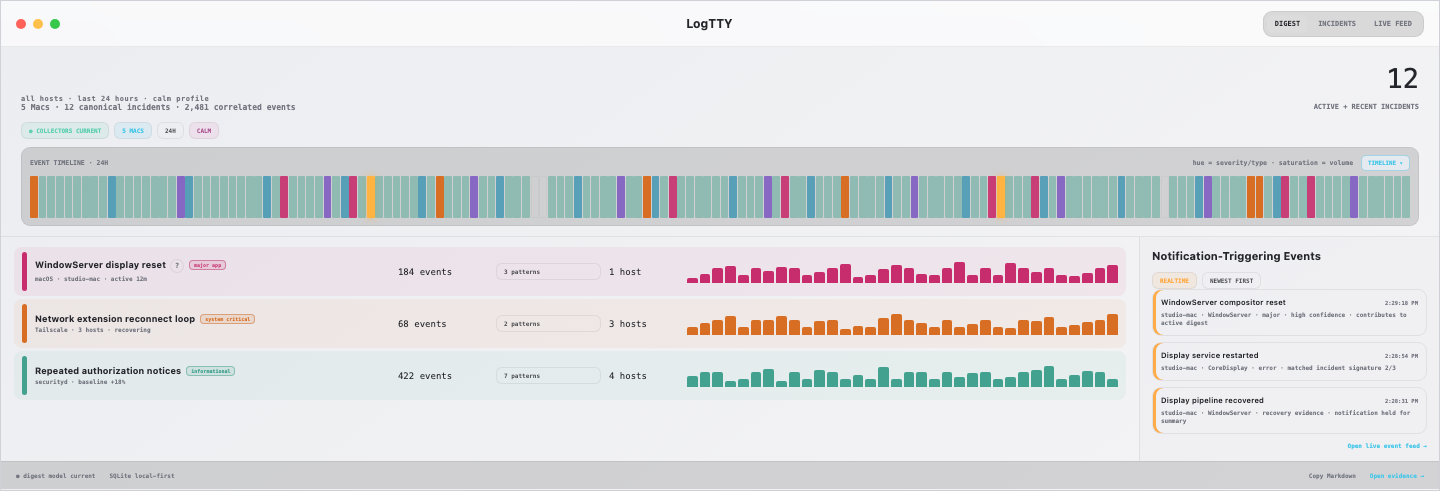
current macOS interface
event review
LogTTY organizes collected events without hiding source state, access limits, or incomplete evidence.
Current-process OSLog collection is active; broader system evidence remains permission-bounded.
Group related events while retaining the underlying event count and source information.
Choose an Apple Unified Logging .logarchive; the original archive is not modified.
Choose compatible timeline views while keeping unavailable sources and incomplete evidence visible.
interface examples
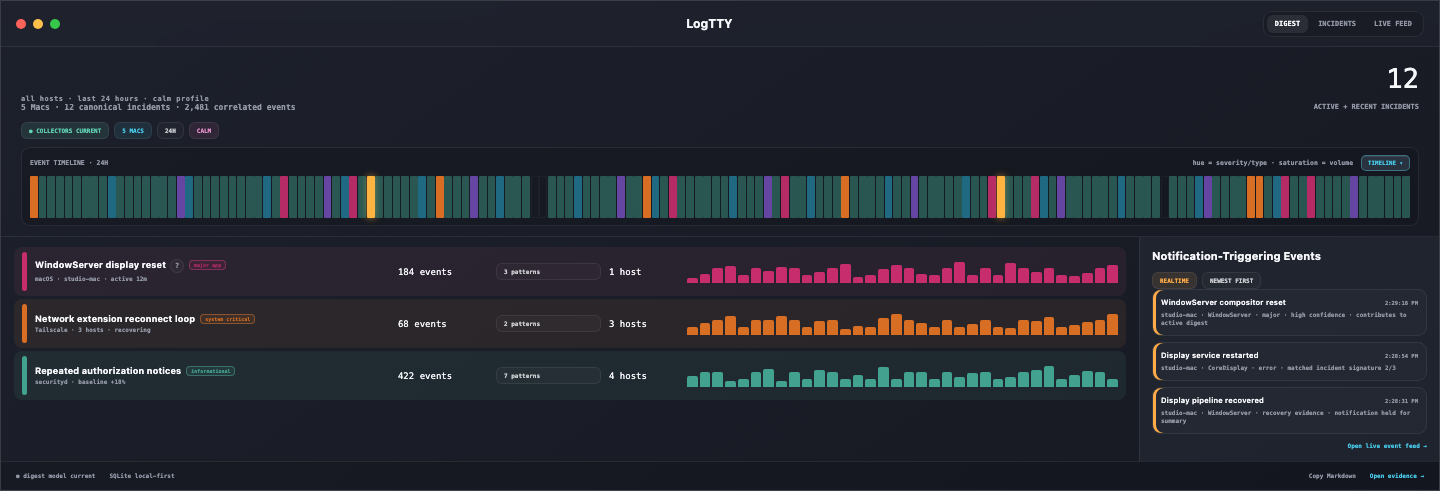
01The macOS digest combines severity, event volume, incident rows, and notification-triggering events.
02The current macOS Live Feed tab reports that it is not connected; collection authorization is a separate boundary.
03iOS has local evidence and source/application filters; paired-Mac CloudKit digest sync is not configured in the current build.
Review the technical examples →data handling
01Current collection begins with app-controlled local sources and explicit imports.
02Unavailable permissions and truncated or dropped events remain visible as collection state.
03LogTTY has no developer backend or active CloudKit synchronization.
04This site does not use marketing analytics.
compatibility and support
LogTTY requires macOS 14 or later, or iOS or iPadOS 17 or later. Current platform scope and diagnostic-reporting guidance are documented here.